A rug can be the right color and still make a seating group feel disconnected. Usually the issue is its footprint: it stops before the furniture, leaves one chair stranded, or reaches a doorway in the wrong place. This living room rug size guide begins with the arrangement of your seats, because that is the area the rug needs to support.
Measure and test before choosing a pattern. Product labels describe the rug, not the relationship between your sofa, chairs, table, doors, and floor. A common size is a starting option, not a guarantee that it suits a particular room. The most useful choice links the group while leaving the surrounding space workable.
Measure the seating group first
Write down the width and depth of the sofa and each chair in its intended position. Include projecting legs, arms, and any movement the furniture requires. Mark the location of the coffee table and the main route through the room. If the furniture arrangement is unresolved, settle it before using a rug to define it.
Our living room furniture arrangement guide explains that sequence. A rug should reinforce a useful plan rather than conceal an awkward one. If you move the sofa after ordering, the same rug may have a very different relationship to the group.
Measure the available floor as well. Include door swings, floor-level changes, vents, heating equipment, and built-ins. Check whether a thicker rug and pad would interfere with a door that currently opens over bare floor. The right visible dimensions do not guarantee that the complete rug assembly works in that location.
Compare the three main placement approaches
Front legs on the rug
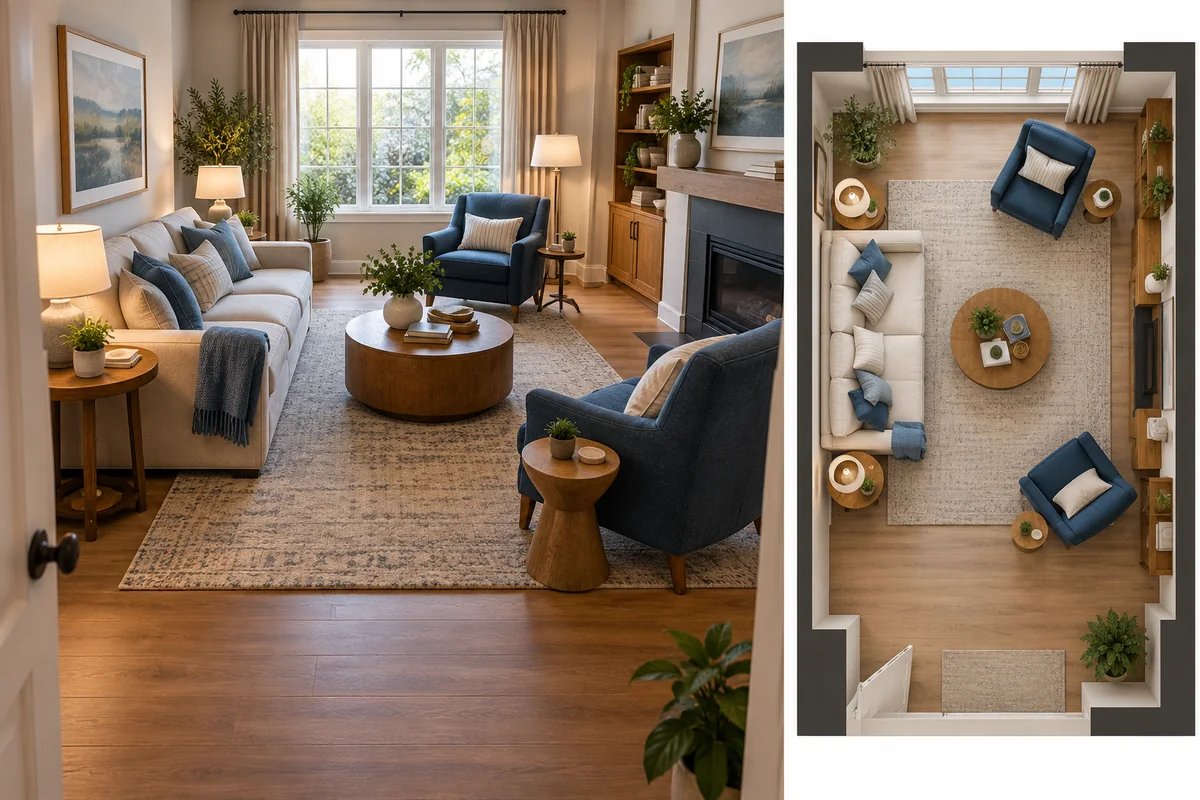
Placing the front legs of the sofa and participating chairs on the rug can connect the group without covering the entire furniture footprint. The amount of overlap must be sufficient for a stable, intentional placement. Avoid a situation where a supporting foot sits precariously on the very edge.
Check all the seats, not just the sofa. A rug that fits under the sofa's front feet but misses a chair may not create the coherent group you expected. Moving the chair slightly or choosing another rug size may solve the problem. Do not stretch the arrangement so widely that conversation becomes awkward simply to match the rug.
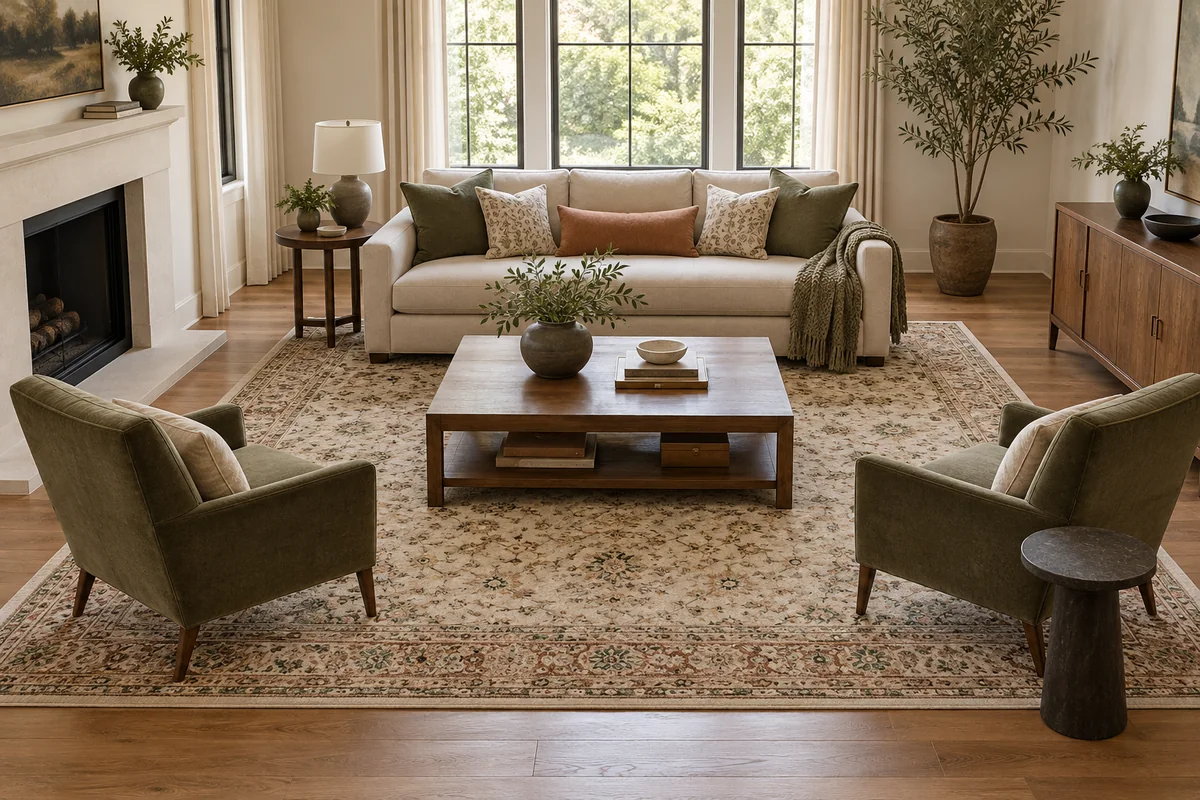
All furniture legs on the rug
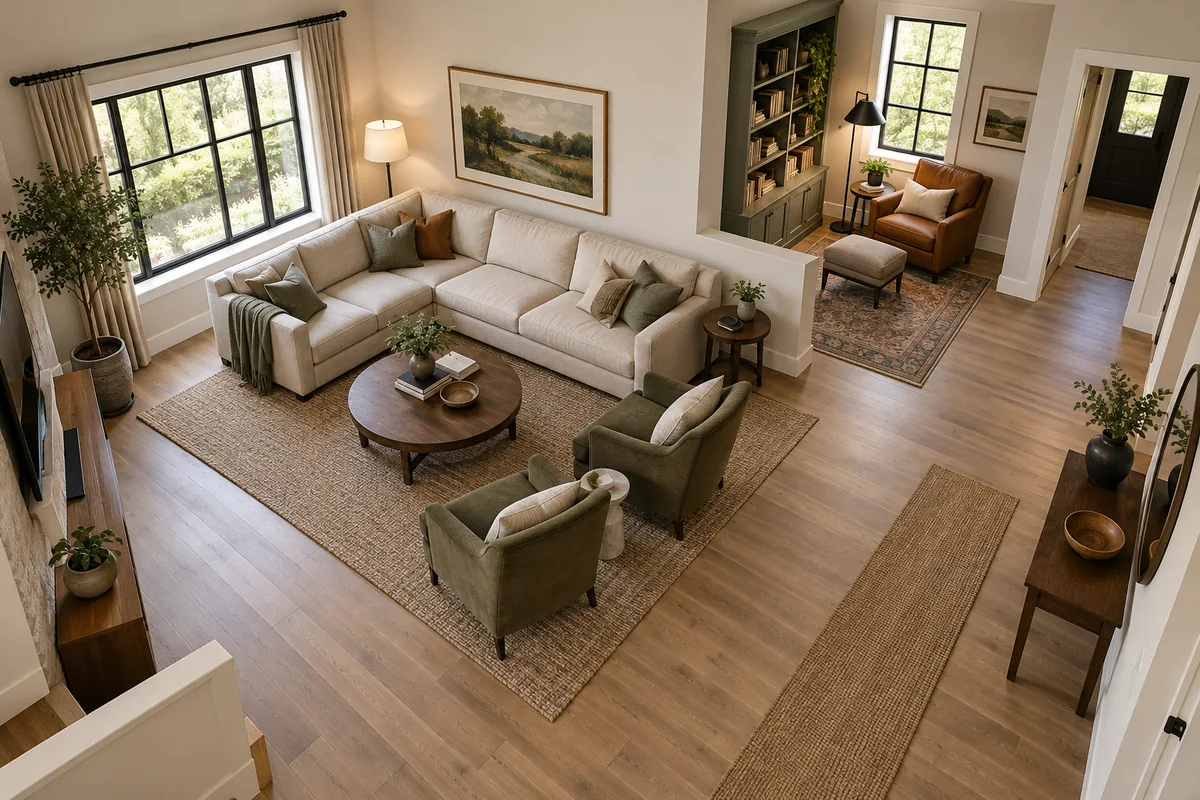
A larger rug can hold the whole seating group and make a defined island within an open-plan space. Include the furniture's full depth and whatever visible border you prefer around it. Check the floor beyond the rug as carefully as the furniture on top of it.
This approach needs enough area to avoid pressing the rug against unrelated storage or doorways. It is not automatically more sophisticated than the front-legs option. Choose it when the actual group and surrounding room support it, rather than using size alone as a measure of quality.
A rug clear of the seating legs
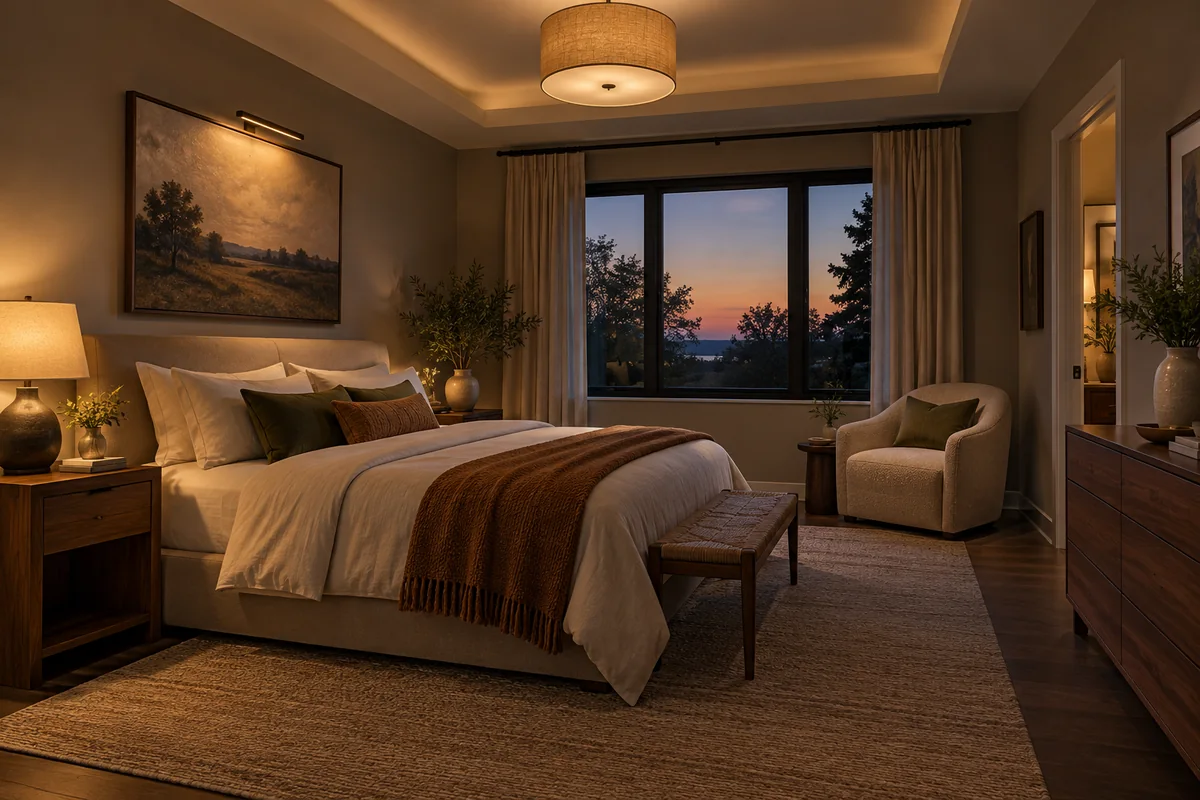
A smaller rug can sit beneath a table in some arrangements, particularly when the group is compact and the purpose is decorative. It creates less of a visual connection between seats. Test whether it reads as an intentional center or a small object floating in an otherwise unrelated arrangement.
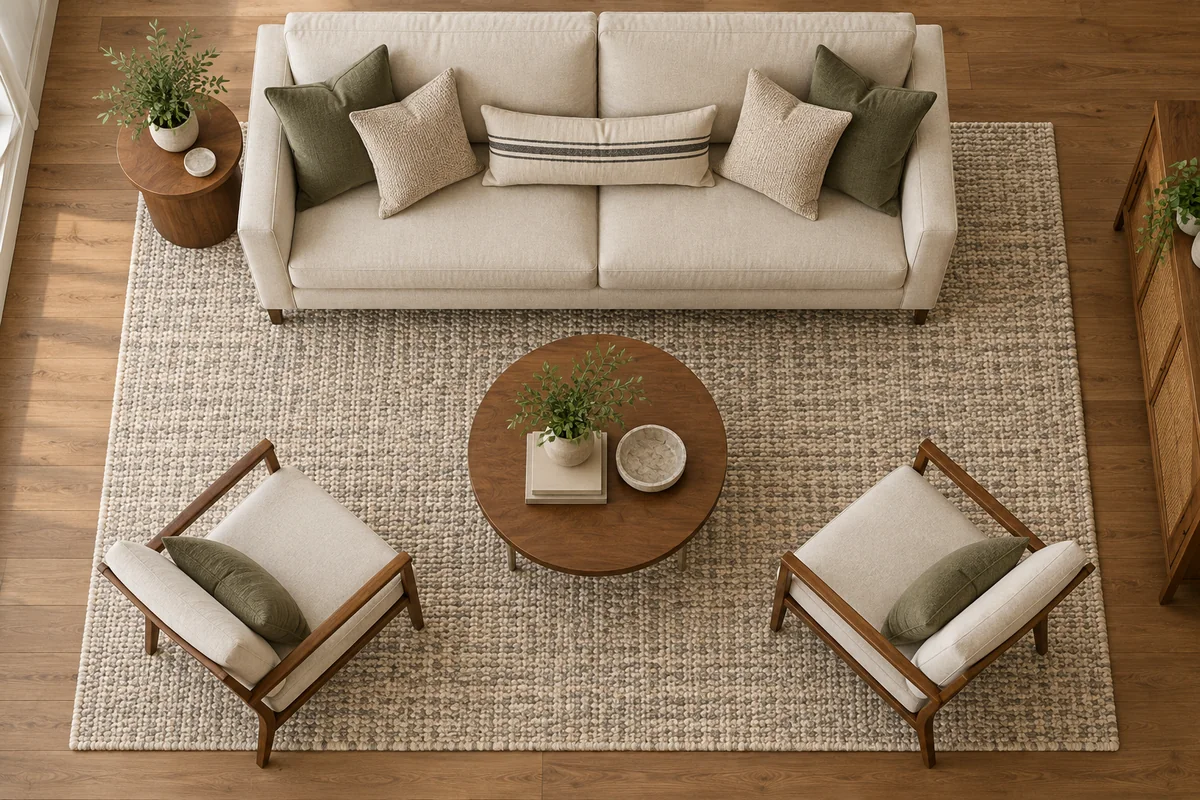
Common living room area rug dimensions
The following sizes are common shopping references, not recommended room sizes. Retailer dimensions and metric equivalents may vary, so confirm the exact specification and manufacturing tolerance for the product you are ordering. A nominal size is not a substitute for the actual measurements.
| Nominal rug size | Approximate metric equivalent | What to test |
|---|---|---|
| 5 by 8 feet | 152 by 244 centimeters | A compact central area; check whether seats become disconnected |
| 6 by 9 feet | 183 by 274 centimeters | A smaller seating group with carefully tested furniture overlap |
| 8 by 10 feet | 244 by 305 centimeters | Many medium seating groups, depending on sofa and chair positions |
| 9 by 12 feet | 274 by 366 centimeters | A broader group or more complete furniture coverage |
The table deliberately avoids assigning a rug to a room just because the room has a particular area. A long narrow arrangement and a square conversational group can occupy the same floor area yet need different rug proportions. Measure the group in both directions.
Work through a sofa-and-rug example
Suppose a sofa is 84 inches wide, about 213 centimeters, and the rug is oriented with its 96-inch side across the sofa. The difference is 12 inches, leaving 6 inches, roughly 15 centimeters, beyond each sofa end if centered. That arithmetic tells you only the side extension, not whether the complete group fits.
Now add two chairs positioned beyond the sofa's width. Their front feet may fall outside that 96-inch span. A wider orientation or larger rug might work better, or the chairs may need a more useful relationship to the sofa. Test all three possibilities rather than buying a bigger rug automatically.
The other rug dimension determines how far the rug extends into the room and under the sofa. A rug rotated ninety degrees can change the result substantially. Mark both orientations if the pattern allows it. Remember that a directional motif or fringe may make one orientation more appropriate than the other.
Test the footprint on the actual floor
Use removable markers suitable for the floor finish, paper, or a temporary outline to show the rug's corners. Leave the outline in place while using the room, if it is safe to do so. Open doors, walk the main route, and look at the arrangement from the entrance and from each seat.
Check the relationship to the coffee table. It does not have to be centered in the room, but it should relate to the seating and remain reachable. A rug can be centered on the group rather than the architecture if the room's functions justify that decision.
For conventional placement illustrations, Rugs USA's sizing guide provides a useful manufacturer reference. Treat retailer advice as a starting point and test it against your furniture, chosen product, and room. A diagram cannot show every opening or access need in your home.
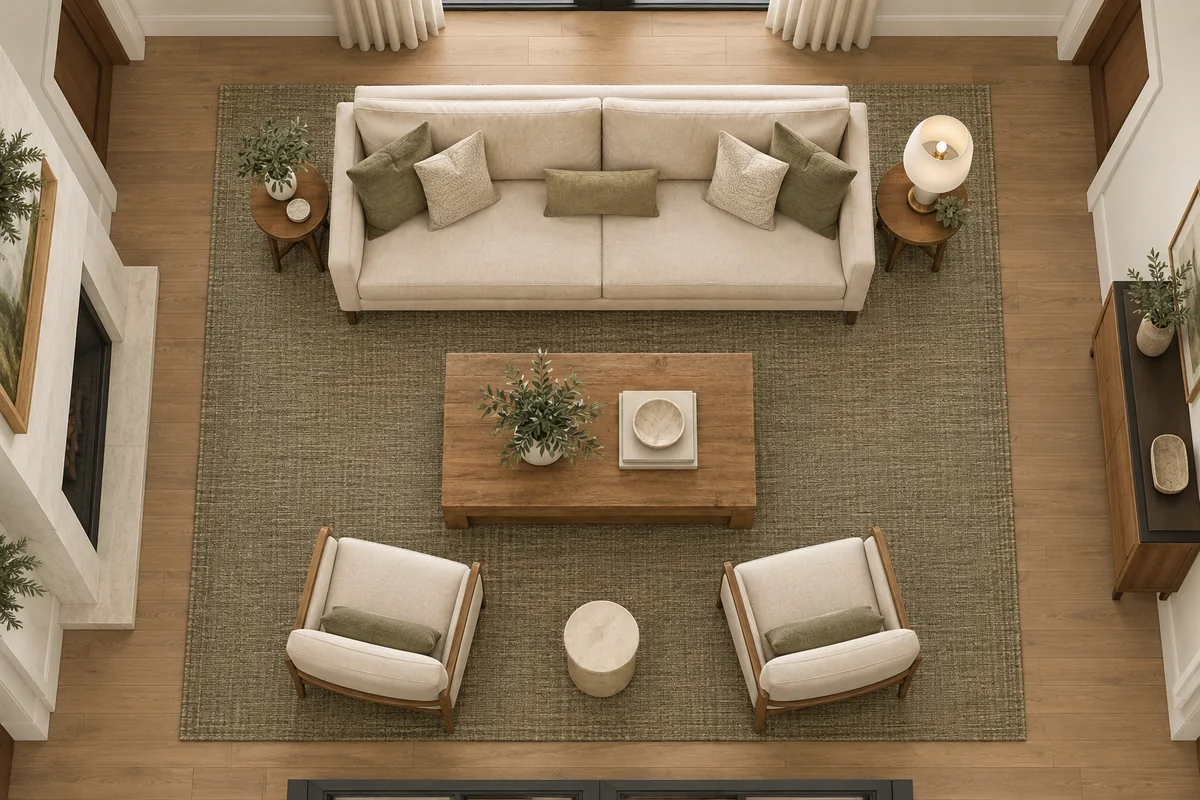
Sectionals and irregular rooms need a fuller outline
A sectional's visible shape can mislead a quick measurement. Include the chaise's projection and identify which supporting feet should sit on the rug. Do not measure only the straight sofa portion, then assume the extension will fall into place. A taped outline makes that mismatch easier to spot.
In an L-shaped or irregular room, let the rug support the activity zone rather than follow every wall. The whole room may not need a rug shaped like its floor plan. Our awkward living room layout ideas discuss separating zones when one large group cannot serve the footprint well.
For two distinct seating areas, compare one rug with two separate rugs only after the furniture works. Additional edges can make a narrow room busier, and a second rug is unnecessary if the secondary area already feels clear. Choose the simplest floor treatment that supports the activities.
Choose shape according to the group
A rectangular rug often aligns easily with a sofa and chairs, but round and irregular shapes can work where their boundaries remain understandable. With a round rug, measure the diameter and check the position of every foot. The curved edge may reach some seats while withdrawing from others.
Do not assume a round rug fixes an awkward room simply because it has no corners. Its widest footprint still occupies floor area, and its edge may intersect a route differently from a rectangle. Use the same full-scale test rather than relying on the product image's visual softness.
Pattern can affect how a size feels. A strong border makes the edge prominent; a quieter design may blend more gently with the floor. Neither changes the actual dimensions. Choose the placement first, then decide whether the pattern supports the relationship you established.
Include the pad and pile in the decision
Check the rug maker's guidance for a compatible pad and the floor manufacturer's care requirements. Thickness, grip, and material matter in addition to size. A pad should suit the floor and rug rather than being selected only because it is discounted or described as universal.
Look at doors and furniture stability with the complete thickness in mind. A deep pile can feel different under a chair from a flat weave, and a table may respond differently when some feet sit on a rug and others on bare floor. Assess the actual furniture rather than assuming every placement is equally stable.
Think about maintenance before choosing the largest possible rug. Confirm how it is cleaned, whether furniture must move for care, and whether the material suits the household. A generous footprint is useful only if you can manage the product over time.
A final buying checklist
- Confirm exact dimensions, orientation, and any fringe.
- Mark the full rug footprint around the actual seating arrangement.
- Check each participating chair as well as the sofa.
- Test doors, routes, floor transitions, and the complete rug-and-pad thickness.
- Review care requirements, return conditions, and delivery handling.
Choose the rug that makes the seating group feel connected while preserving the room's useful space. The right dimensions are not a universal number under every sofa. They are the result of a measured arrangement, a workable edge, and a product suited to the way the room is used.
Images are AI-generated design illustrations, not photographs of documented projects. Conceptual layout illustrations are not measured plans.
About editorial attribution ↗