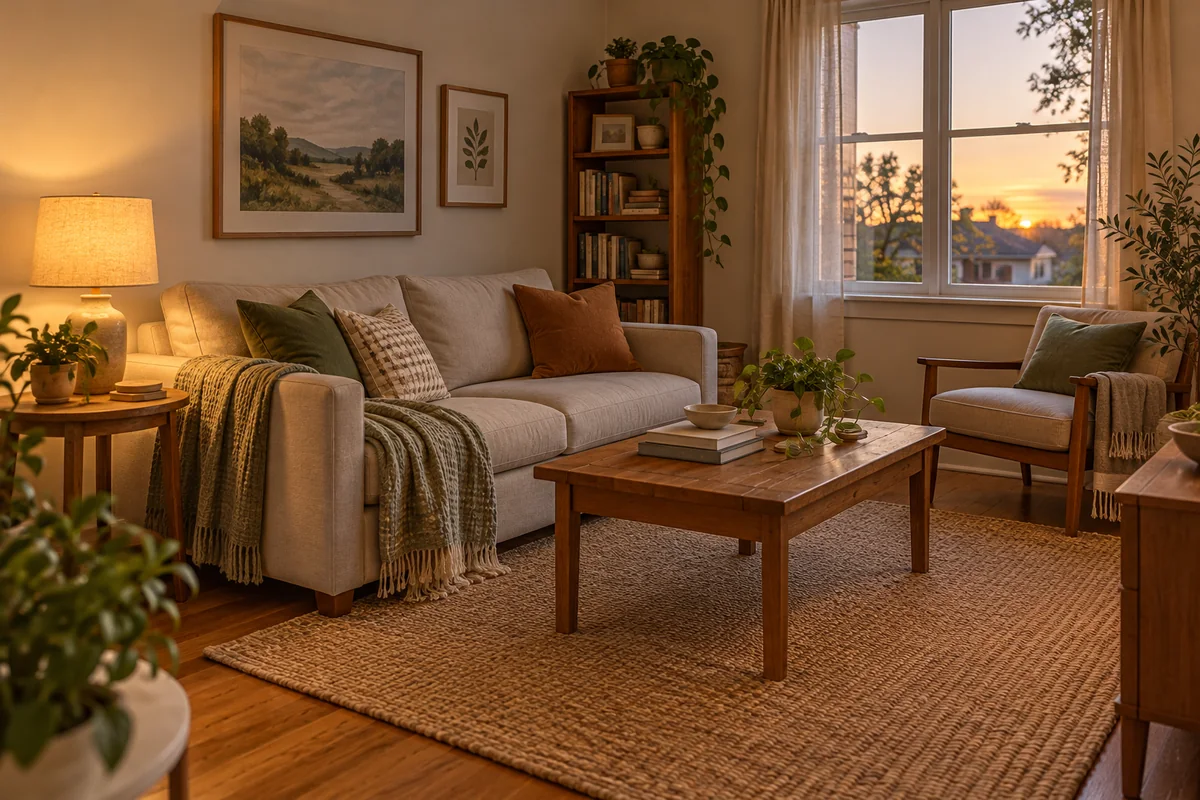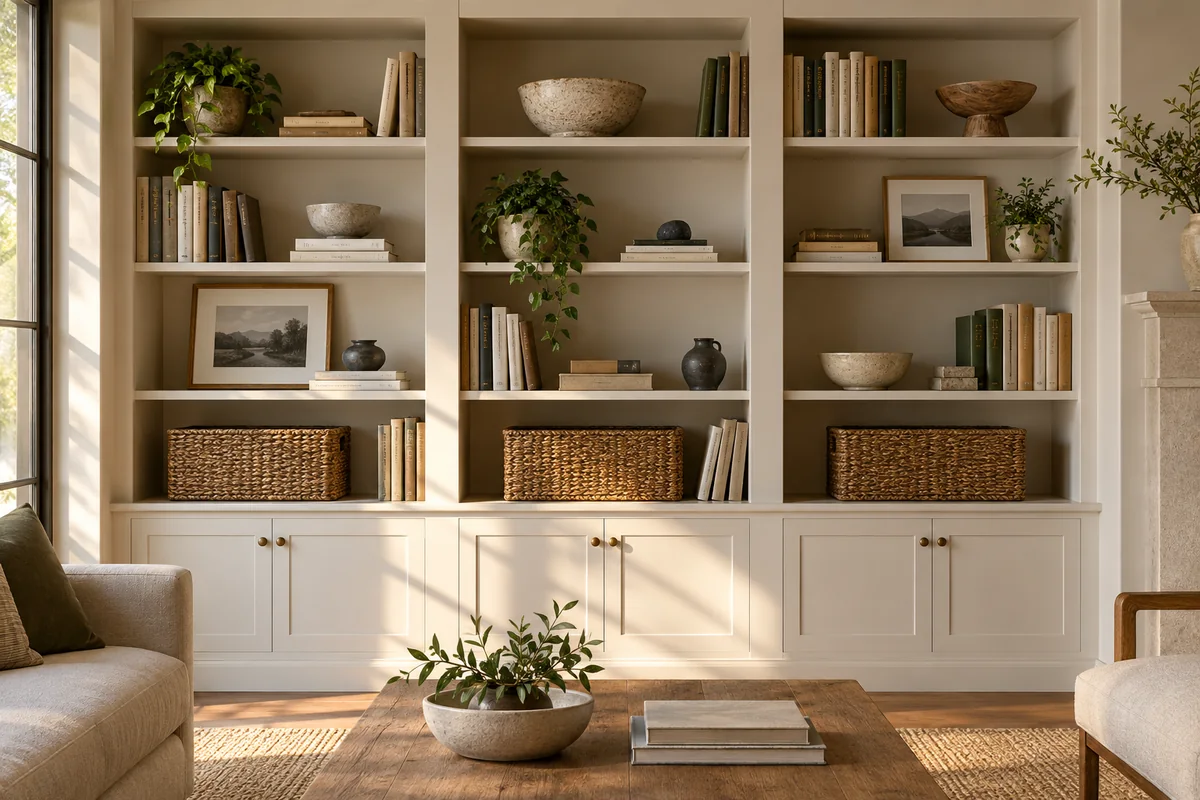
One bright ceiling light can make a bedroom visible without making it comfortable. You may still struggle to read, find clothes in a dark wardrobe, or settle down without glare. The most useful bedroom lighting ideas separate those activities and give each the kind of light it needs, rather than asking a single fixture to do everything.
Think of ambient lighting as the room's general background, task lighting as light for a particular activity, and accent lighting as a way to emphasize a surface or object. These layers can overlap, and a modest room may need only a few well-chosen sources. Start with the existing electrical points and the routines that happen around the bed.
1. Make the general light comfortable to live with
Assess the room after dark from the doorway, bed, and dressing position. Notice whether the existing ceiling source creates glare or leaves important corners difficult to use. A shade or diffuser suitable for the fitting may change the experience, but check compatibility and the manufacturer's requirements before altering anything.
General light does not have to be equally bright across every surface. It does need to help you move and find things. Avoid assuming a decorative fitting is sufficient because the bulb is bright; the shade, direction, room finishes, and position all influence where light actually goes.
If the room has only one source, start by identifying the activity it serves least well. A useful lamp near that activity may offer more improvement than a more elaborate ceiling fixture. Keep additions proportionate to the room and do not introduce cords across the route to the door.
2. Give bedtime reading its own source
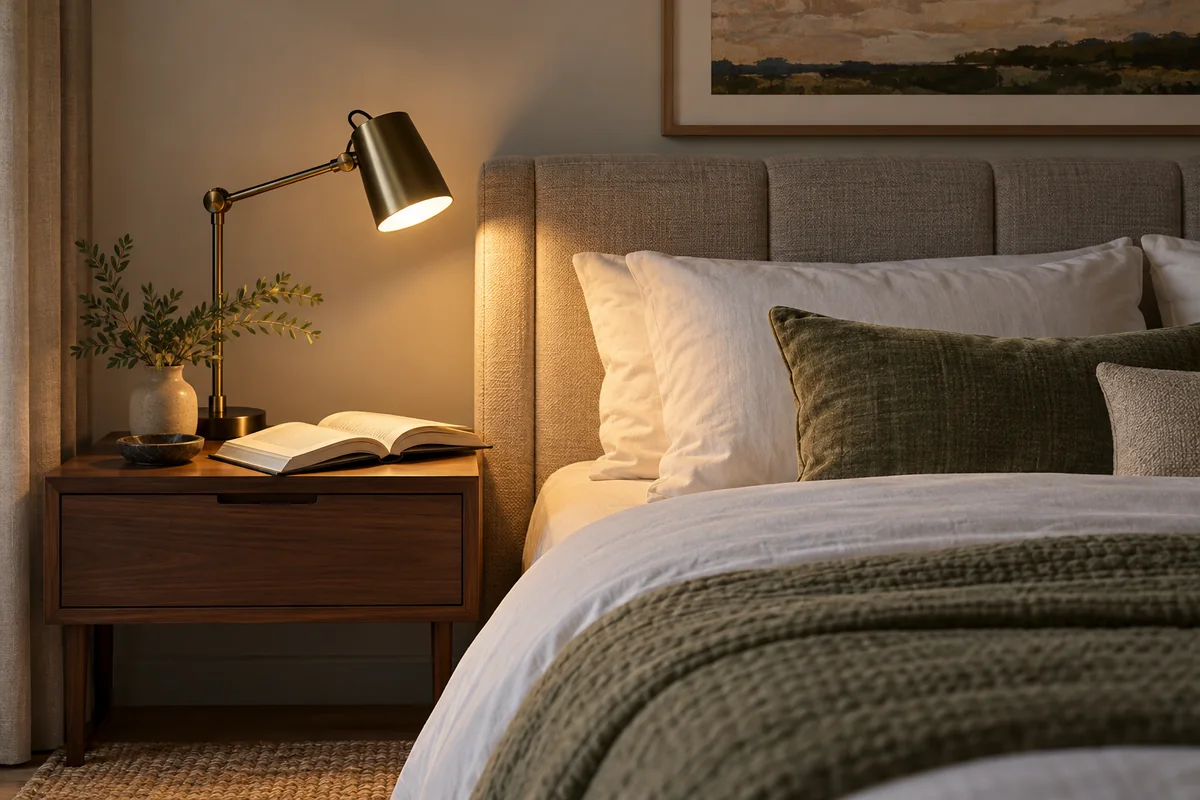
A reading lamp should illuminate the page without placing a bright bare source directly in your eyes or disturbing another person unnecessarily. Test the lamp while sitting in the position you actually use. A photograph of an attractive bedside arrangement cannot show the glare experienced from the pillow.
Adjustability can help, but check that the range of movement reaches the book and remains stable. Consider how you operate the switch and whether it is easy to reach. A lamp that requires sitting up and leaning across a table each time may be inconvenient despite its compact footprint.
The table must still hold the objects you need beside the bed. If a lamp consumes the entire surface, compare a smaller suitable lamp or a properly installed wall-mounted option. Fixed work should be assessed by an appropriately qualified professional; this is a placement brief rather than wiring guidance.
3. Treat each bedside as a separate task
Two people may read at different times, need different positions, or prefer different light levels. Matching lamps can work, but they are not more important than independent usefulness. Test the angle and controls on both sides rather than assuming a symmetrical plan performs equally well.
One side may have a larger nightstand or a different relationship to an outlet. Let the mounting or furniture respond to those conditions. The room can still feel connected through related materials or shade shapes even if the two arrangements are not identical.
Keep the route beside each bed usable. A floor lamp with a broad base can occupy valuable movement space, especially in a compact room. A narrow visual silhouette does not mean a small actual footprint, so measure the base and any projecting arm before choosing its position.
4. Light the dressing activity, not just the mirror frame
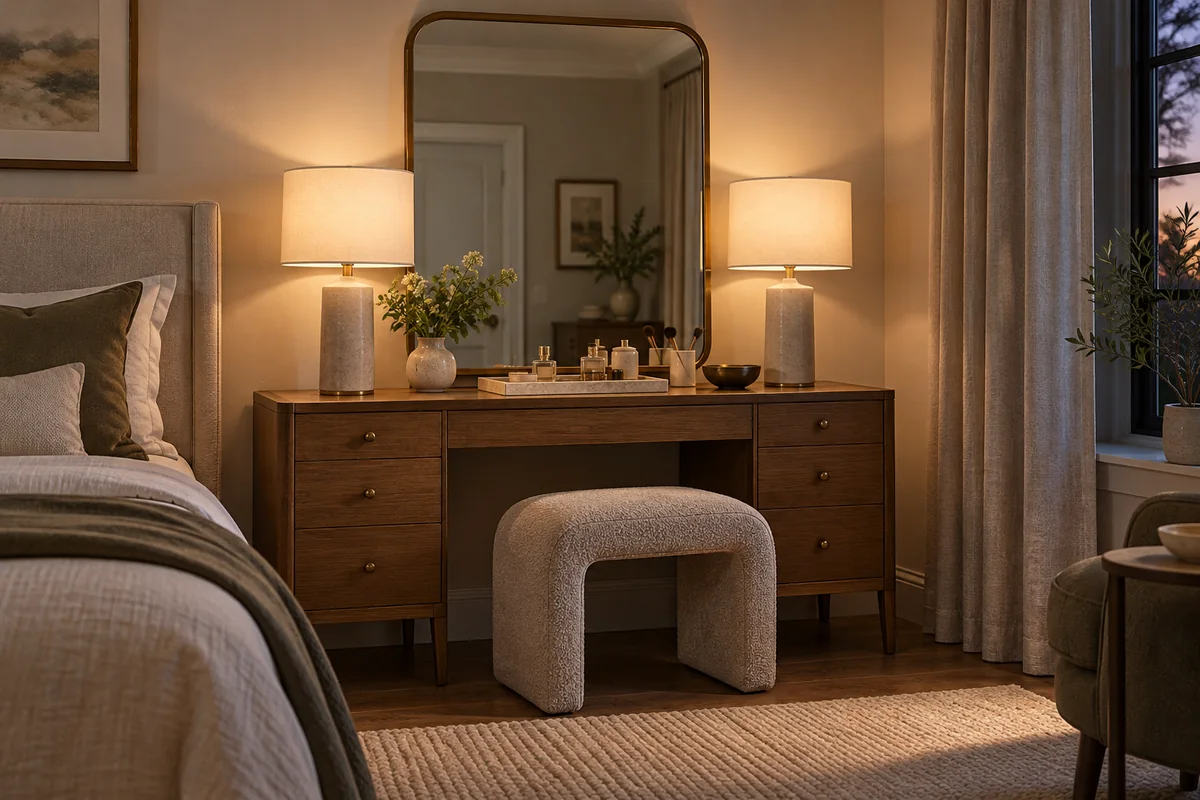
Stand where you choose clothes and use the mirror. A bright source behind your head may leave your face or clothing in shadow. Compare the light from the actual standing position rather than evaluating the fitting from across the room. Balanced, comfortable illumination matters more than a dramatic mirror surround.
For a dressing table, identify the task: applying makeup, handling small objects, or simply checking an outfit. Those activities can need different light distribution. Avoid buying a fixture only because its promotional photograph makes the mirror look attractive; assess controls, glare, placement, and the installation information.
Color perception also matters when combining clothes or judging fabric samples. Ask for the product's relevant specifications and test the result where possible. A light that feels atmospheric near the bed may not be the most useful choice for every dressing task.
5. Understand brightness and light appearance separately
Lumens describe light output; watts describe electricity use. Correlated color temperature, expressed in kelvin, describes light appearance. A lamp can look warm while providing substantial output, or look cooler while still leaving a task inadequately lit. Avoid using one specification as a substitute for all the others.
Energy Rating's guide to choosing a lamp gives examples ranging from warm light around 2,700 K to cooler appearances. Treat these as descriptions, not a universal instruction for every bedroom. Your preference, the fixture, surrounding surfaces, and the task all influence the result.
Compare lamps in the actual room when practical. Warm light can change the way paint and textiles appear, so make final color decisions under the lighting you intend to use. If one corner looks disconnected, check whether the light appearance differs before assuming the wall or furniture is the problem.
6. Use dimming where the complete setup supports it
Dimming can make one source useful at different times, but the lamp, fitting, and control need to be compatible. Read the product guidance and seek professional help for fixed controls. Do not assume every LED bulb will behave well with an existing dimmer simply because it fits the socket.
Test the useful range rather than only the brightest setting. Flicker, an abrupt cut-off, or an unsuitable minimum level can make a theoretical feature frustrating in practice. A straightforward separate lamp may be more appropriate than an incompatible dimming setup.
Controls should be understandable to the household. An elaborate system is not an improvement if ordinary use requires several steps or another device that is not available at night. Choose the simplest arrangement that supports the activities and any accessibility needs.
7. Add accent light only where it explains something
A subtle source on an artwork, textured wall, or reading corner can give the room depth after dark. Identify the surface you want to reveal before buying a decorative fitting. Light does not need another object to justify it, but it should contribute to the view or activity.
Avoid turning every shelf, bed edge, and ceiling line into a lit feature. Too many separate effects can create visual activity at the time you want the room to feel quieter. A small number of useful sources often gives a clearer result than a collection of unrelated decorative lights.
Our warm minimalist bedroom ideas explore using texture and light without increasing clutter. The same principle helps here: let one surface become legible and allow other areas to remain more subdued, while keeping movement and tasks adequately supported.
8. Check the early-morning and night-time route
Consider how someone moves from the bed to the door or another regularly used destination. A low-level solution may be helpful if it is appropriate to the room and users, but its placement, brightness, and controls still need assessment. Do not place a loose light or cable where it creates a new obstacle.
Keep essential switches accessible and avoid relying on a light that another person must cross the room to operate. Household needs vary, including vision, mobility, and sensitivity to glare. Test the arrangement with the people who use it instead of treating one level or product type as universally suitable.
If the route remains awkward, review the furniture as well as the light. Better illumination cannot make a blocked passage usable. Move a projecting table or reconsider the storage position rather than treating more light as a complete solution.
9. Improve existing lighting before buying a full set
Start with a safe, compatible bulb choice, a better lamp position, or an existing shade that suits the fitting and task. Check manufacturer limits and product instructions. Never cover a bulb or improvise a shade to soften light, and keep fabrics away from heat sources as directed.
For modest changes, our cozy home ideas on a budget helps prioritize the useful additions. A single effective reading lamp may improve the bedroom more than several decorative pieces. Keep the purchase tied to a task you can name and test.
Choose the combination by an evening routine
Compare the shade as part of the complete lamp, not as a separate decorative purchase. An opaque shade can direct light differently from a translucent fabric, and an exposed lower edge may reveal the source from bed height. Product dimensions alone will not show that view. Test a returnable compatible option where practical, or ask for useful photographs and specifications before ordering. Keep the fitting's ventilation and product limitations intact. The most appealing shade in daylight is not necessarily the one that supports the evening task.
Walk through getting ready for bed, reading, switching lights off, and moving around later. Then test getting dressed the following morning. The right combination may be one general source, two independently useful bedside lamps, and a light for a darker task area; another room may need a different arrangement.
Keep the successful layers and remove effects that contribute little. A cozy bedroom is not necessarily dim everywhere. It is a room where the light supports what you are doing, where glare is controlled, and where the transition between activity and rest feels straightforward.
Images are AI-generated design illustrations, not photographs of documented projects. Conceptual layout illustrations are not measured plans.
About editorial attribution ↗