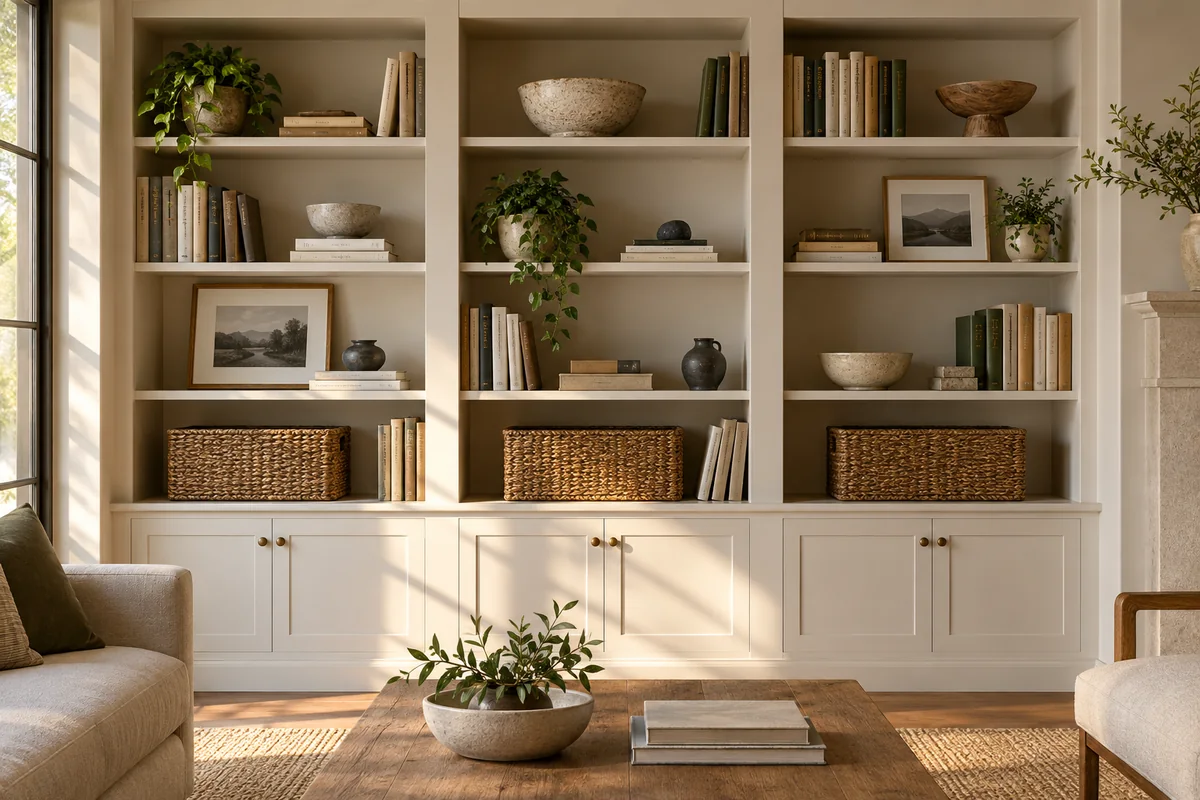
A shelf can look cluttered even when it holds relatively few objects. The issue is often that everything competes at the same scale or sits in front of something you need to reach. Learning how to style open shelves starts with separating useful storage from display, then arranging both so the shelf remains easy to understand and use.
Do not empty your bookcase only to replace it with objects chosen for a photograph. Keep the things the room actually needs. The task is to give them a workable arrangement: accessible books, stable objects, a few clear groupings, and some unoccupied surface. Different households will reach that balance with different amounts of visible material.
Prepare the shelves before arranging objects
Check shelf depth, height, condition, and the manufacturer's load guidance. Follow fixing and anchoring instructions appropriate to the unit and wall. A styled shelf is still a loaded piece of furniture. Health Canada's furniture tip-over guidance is a useful reminder to address restraint before treating the unit as a decorative backdrop.
Remove items temporarily so you can clean and inspect the surfaces. Group them into books, useful objects, personal display, and belongings that need another home. Do not make discard decisions simply because something has an unfashionable cover or color. This is a working storage area as well as part of the room's appearance.
Identify what must stay within easy reach. Daily books, children's materials, or regularly used dishes belong at accessible positions suitable for the people using them. Fragile or heavy objects need secure, appropriate locations. A visually balanced arrangement should never depend on placing an unsuitable object where it is likely to fall.
Step 1: establish the shelf's main job
A bookcase holding a large reading collection needs a different balance from a shallow display niche. Decide which function leads. If books dominate, let them remain visible and organize them for retrieval. If the shelf is primarily for personal objects, select a smaller group and give each enough room to be seen.
Do not require every shelf in the unit to do the same job. Lower shelves might hold everyday supplies in suitable containers, while middle shelves carry books and one personal display. Upper shelves can remain simpler if they are less convenient to reach. Assign functions before moving individual objects around.
The surrounding room matters too. A shelf beside a strong patterned rug or detailed wall may benefit from fewer visual changes. A quiet room can support a more varied collection. Stand back to judge the shelf within that context rather than evaluating it only from a close frontal view.
Step 2: arrange the books for actual use
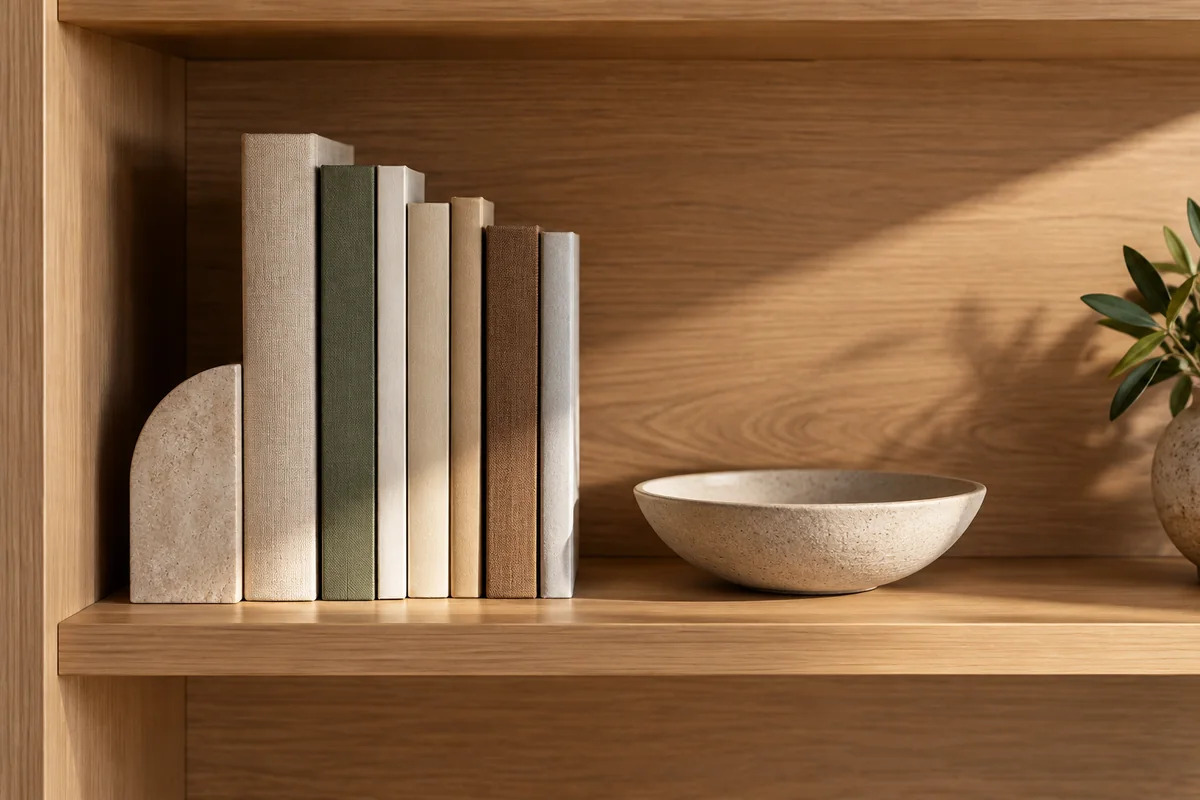
Begin with upright groups that are easy to browse. Use suitable bookends or the shelf sides to support them, without packing the books so tightly that removal becomes awkward. Group by a system you can maintain, such as subject, author, or household use, rather than appearance alone.
A horizontal stack can create a different shape, but avoid using it where retrieving the bottom book means dismantling a decorative arrangement. Keep frequently used volumes in positions that do not require moving a vase first. An appealing bookcase should still encourage reading.
Book spines introduce color and detail naturally. You do not have to hide them or turn books backward to create order. If the visual activity feels excessive, consolidate books into clear blocks and simplify nearby display objects. A defined book area often reads more calmly than small groups distributed without a purpose.
Step 3: choose a few objects with distinct silhouettes
Compare the outlines before worrying about exact color matches. A framed image, a low bowl, and a taller vessel provide different shapes. Several similarly sized ornaments may blend into a busy row even if they share a palette. Keep the objects that have meaning or a useful function rather than buying a complete shelf-styling set.
Give a larger object enough surrounding space to be recognizable. It can sometimes replace several smaller pieces that were all trying to add interest. Check whether its depth and base fit securely on the shelf, especially if a frame leans rather than hangs. Follow appropriate mounting or securing guidance for the item.
Personal photographs can remain part of the arrangement. A limited group of related frame sizes may make them easier to read than many competing outlines. You do not need to remove their personal character; simply consider which images you want to notice from the room's main seating position.
Step 4: group objects without repeating a formula
A pair, a small cluster, or a single substantial object can all work. There is no need to apply a fixed odd-number rule to every shelf. Instead, notice the group's width, height, and empty space beside it. Vary those relationships according to the objects you own.
Try one asymmetrical group, then leave the adjacent area quieter. On the next shelf, the balance may sit elsewhere. The aim is a unit that feels connected without repeating the same stack-bowl-vase pattern from top to bottom. A recognizable template can make even personal objects feel staged.
Use material repetition selectively. Timber, ceramic, woven fiber, or a color in an artwork can connect different shelves. Do not force every item into a narrow palette if that makes useful possessions difficult to store. Order can come from grouping and scale as well as color.
Step 5: protect space for retrieval and reset
Reach for the things you use while the arrangement is in place. If a hand has to navigate several ornaments to retrieve a book, move the ornaments. If a basket catches the shelf above, change its position or size. A shelf that works only when untouched is a display, not practical household storage.
Containers are useful for small miscellaneous belongings, but measure internal dimensions before buying. A basket that fits the shelf may have handles that prevent removal, or a narrow opening that makes its contents hard to reach. Choose according to the objects and access, not just the front appearance.
Our small home organization guide explains establishing categories and capacity before buying containers. On open shelves, that approach also reduces the number of unrelated packages and small items competing in the view. Keep the system simple enough that belongings can return without a lengthy reset.
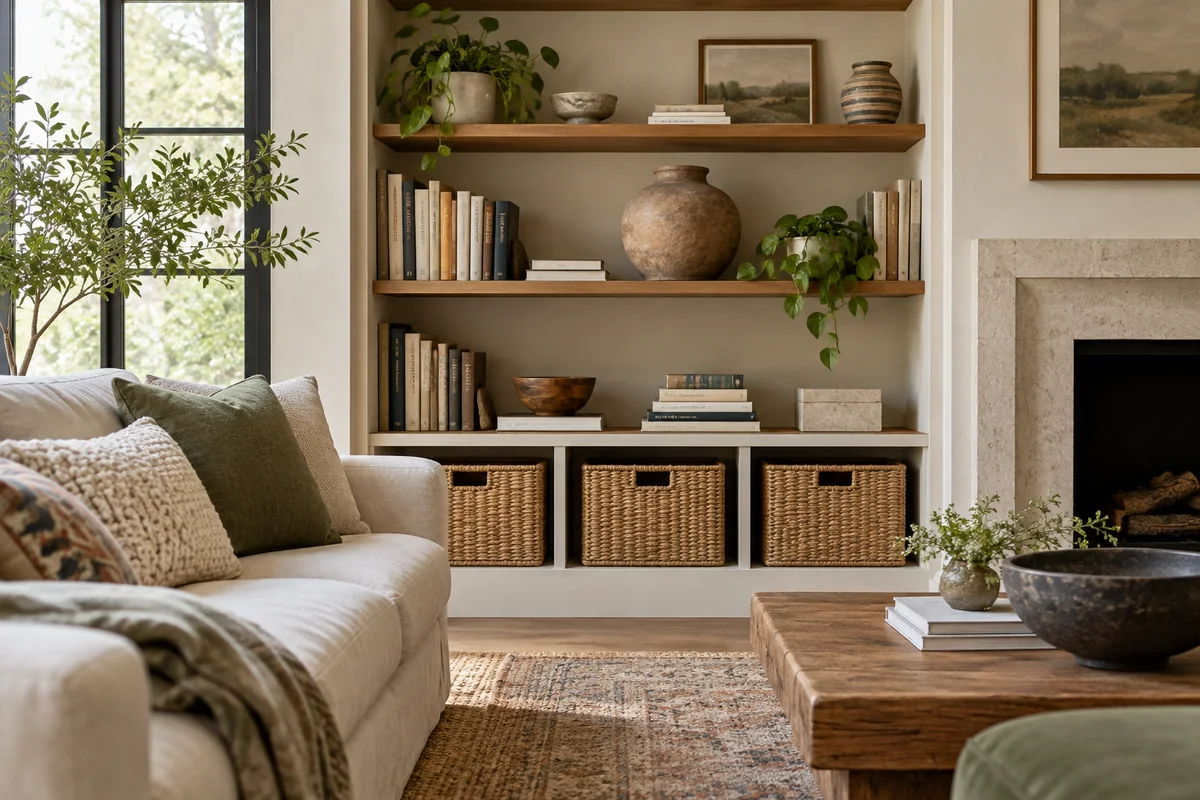
Step 6: assess the whole unit from the room
Step back to the main entrance and then sit where you normally sit. Notice where your eye stops and which areas appear crowded. The shelf may look balanced from directly in front but heavy on one side from the sofa. Adjust the larger groups before fine-tuning small accessories.
Check vertical relationships. A tall object repeated directly above another tall object can create a strong column, which may or may not suit the unit. Shift a group if that line feels too rigid, but do not make changes solely to achieve diagonal arrangements seen in styling diagrams. Let the real objects lead.
Take a reference photograph for your own comparison, then remove one questionable object. If the shelf becomes clearer and loses no useful function, keep the simpler version for a few days. This is a more informative test than continually adding objects until every gap is filled.
Adapt the method to the room
Living room shelf decor
Keep everyday books and activities within convenient reach. A few larger personal objects may be enough beside them. If a television or large artwork is nearby, assess whether the shelf needs to be quieter so the room does not have several equally busy focal points.
Kitchen open shelving
Choose items that are appropriate to store openly and realistic to keep clean. Frequently used dishes may return naturally to a defined area, while occasional decorative pieces can create unnecessary obstacles. Consider the shelf's distance from cooking activity and the care needs of its contents, not just its appearance in daylight.
Bedroom shelves
Keep the view from the bed in mind. A reduced group may feel more restful than a collection of work supplies, but practical storage needs still matter. Use suitable closed storage elsewhere if visible administrative clutter is the problem, rather than expecting a shelf arrangement to make paperwork disappear.
Common shelf-styling mistakes worth correcting
Too many small objects create a similar level of detail across the entire unit. Try consolidating them into one meaningful group or moving some elsewhere. Another frequent issue is decoration in front of daily storage. Swap the positions so useful items can be reached directly.
Avoid buying objects only to fill gaps. The empty area may be what lets the existing possessions read clearly. Our timeless home decor guide favors pieces with an ongoing purpose; the same principle applies to the smallest object on a shelf.
A shelf should survive an ordinary week
After living with the arrangement, look for the places where clutter returns. Those spots may need a clearer storage category or easier access rather than more decorative editing. Keep the books readable, the useful objects reachable, and the personal things visible enough to enjoy. The most successful styling is an arrangement you can actually use.
Images are AI-generated design illustrations, not photographs of documented projects. Conceptual layout illustrations are not measured plans.
About editorial attribution ↗